
Table of Contents
Introduction
Buying Swarovski sarees in bulk is a different decision from buying a single piece. One well-finished saree tells you very little about what the five-hundredth piece in the same order will look like. For a retailer searching for a Swarovski sarees wholesaler India has to offer, the real risk lies in inconsistent crystal work, delayed dispatch, vague order terms or a sample that does not match the final goods.
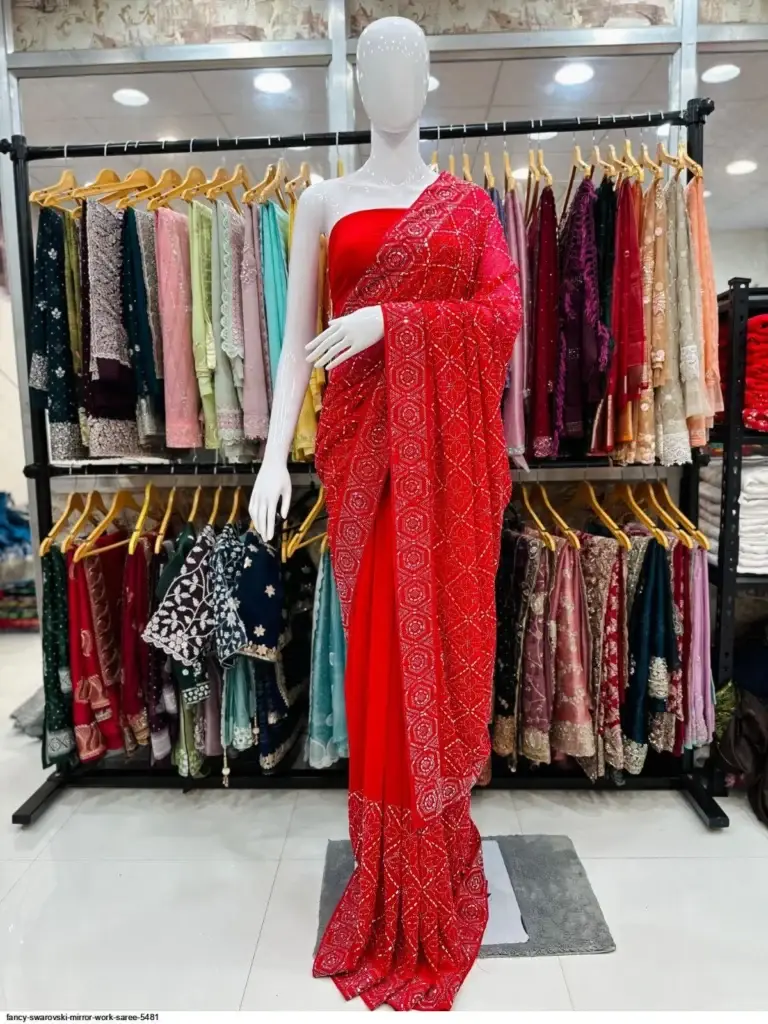
This guide is for business buyers who are comparing a Swarovski sarees supplier in India and want a practical way to assess one before committing money and shelf space. It covers what to inspect, what to ask and what to confirm in writing. If you want to see the kind of product a supplier should be able to show you.
Why the Supplier Matters More Than the Single Product
In a bulk order, the supplier’s process decides the outcome as much as the design does. Two suppliers can show you a similar-looking sample, yet one may be able to repeat that standard across a full production run while the other cannot. Buyers who work with Swarovski embellishment feel this most, because crystal work is detailed, labour-intensive and easy to get wrong at scale.
When you evaluate any Swarovski sarees supplier in India, look past the design catalogue and ask how a design moves from sample to production, who checks the work and how problems are handled. Any Swarovski sarees manufacturer India buyers shortlist should be able to explain this clearly. If a supplier can only talk about designs and prices, you are taking on risks you cannot see yet. The sections below follow the order in which a careful buyer would usually evaluate a supplier.Start With the Quality of the Swarovski Work
Begin with the embellishment, since it is what you are paying for. Ask the supplier to state clearly what crystals are used and in what form. Buyers should not assume that every “crystal work” saree uses the same material, so a direct question about the crystal type and its source is reasonable and professional, especially when you are buying Swarovski sarees wholesale and will describe the product to your own customers.
Next, look at how the crystals are placed. Spacing should be even, the pattern should follow the design without drifting, and clusters should look intentional rather than crowded. Uneven placement is often the first sign of rushed or loosely supervised work.
Then check how securely the crystals are attached. Run your fingers over the work, look at the edges of each stone, and check whether any are loose, tilted or missing. Pay attention to the back of the fabric as well. Poor backing, rough thread ends or visible glue marks can cause discomfort for the wearer and returns for you.
Finally, look at the work in different lighting. Good crystal work should catch light evenly across the saree, and the same tone should carry across the pallu, body and border.Evaluate the Fabric and Overall Construction
Crystal work is only as good as the base it sits on. A heavy embellishment on a weak or unsuitable fabric can pull, pucker or distort the drape over time. When reviewing a sample, check how the fabric handles the weight of the work, whether it hangs naturally and whether the embellished areas stay flat.
Fabric choice also affects how the saree fits your market. A retailer serving bridal customers may prioritise rich, structured fabrics, while a boutique buyer may want something lighter for evening wear. If you are comparing options, fabric-based saree collections give a useful picture of how different base materials change the look and feel of finished work.
Look closely at finishing as well. Check the border, the edges, the fall and the blouse piece, and look at the stitching and any hand finishing. Clean finishing is a good indicator of the supplier’s overall discipline.
Request and Assess a Sample Before Bulk Production
A sample is the most important evaluation tool you have, and it should be treated as a reference standard rather than a courtesy. Before a Swarovski sarees supplier in India begins production, ask for a sample of the exact design, fabric and colour you plan to order, not a similar piece from stock. If the sample differs from your intended order, it cannot tell you much about the final product.
When the sample arrives, review it against a clear list: crystal placement, attachment, fabric behaviour, colour, finishing and packaging. Record your observations and photograph the piece. Then confirm the approved sample in writing and ask the supplier to retain a matching reference piece. This gives both sides something concrete to compare against when bulk goods are inspected.
Be cautious if a supplier is reluctant to provide a sample, or if the approved sample cannot be matched later. A supplier confident in its process will usually welcome a clear approval stage, since it protects them as well as you.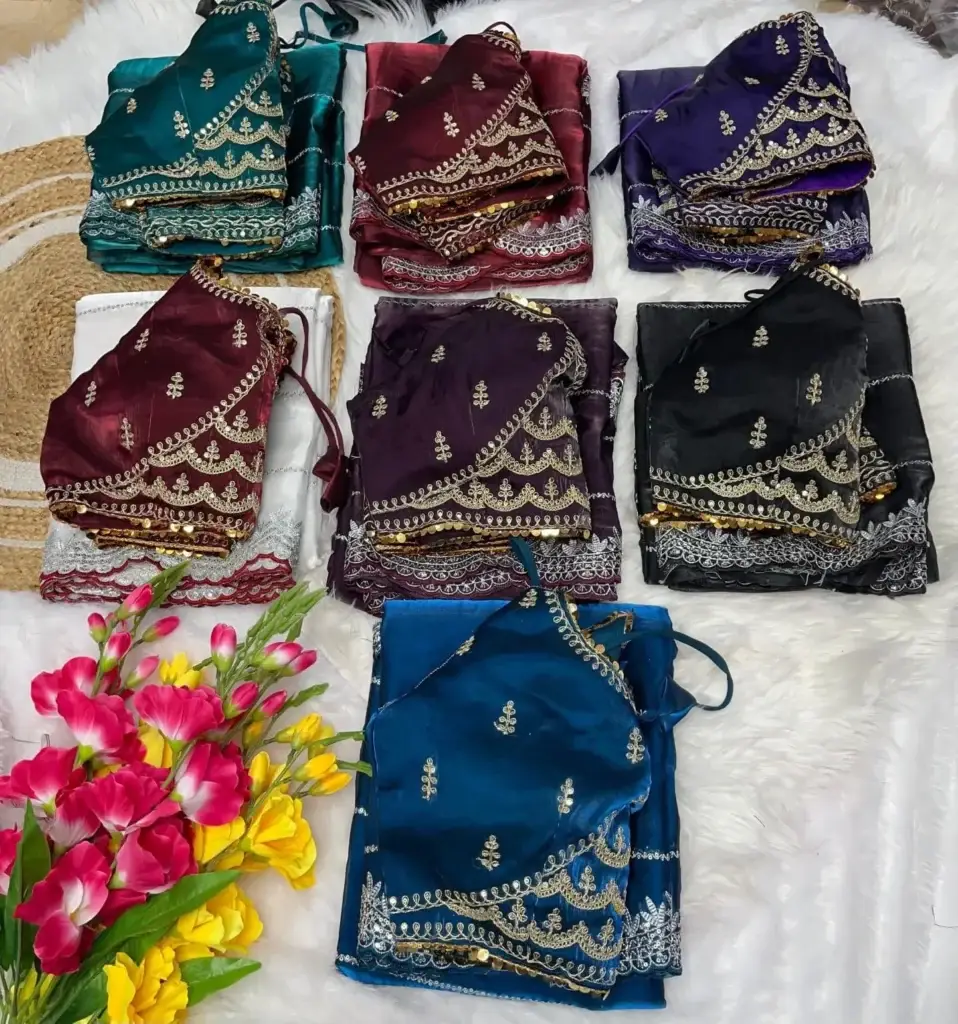
Check Consistency Across Bulk Production
This is where most bulk-order problems appear. A single sample can be made with extra care, while a large run depends on repeatable systems. A bulk Swarovski sarees supplier should be able to explain how it maintains the same standard across many pieces, including how embellishment work is divided among workers, how pieces are checked and how variation is controlled.
Some variation is normal in handcrafted work, so the useful question is how much and what the supplier treats as acceptable. Agree in advance on what counts as a defect and what happens if a delivered batch falls short of the approved sample. For repeat orders, ask how the supplier ensures a re-order will match the first one. Where possible, ask whether a few pieces from the production run can be reviewed before the whole lot is dispatched. Practices like this vary between suppliers, so confirm what is actually offered rather than assuming.Understand MOQ and Customization Requirements
Minimum order quantity differs from supplier to supplier and often depends on the design, fabric and level of customization. Ask for the MOQ in writing for the specific product you want, and clarify whether it applies per design, per colour or across the whole order. Do not rely on a general figure quoted in conversation.
If you need changes, such as a different colour, adjusted crystal density, a modified border or a new design altogether, ask how customization affects MOQ, timelines and cost. When you shortlist a designer sarees supplier India has to offer, the range of design directions also matters. Here designer work sarees page is a helpful place to see that range before you brief a supplier.
If you plan to sell under your own brand, raise private-label needs at the start. Discuss labelling, tags and packaging details, and confirm what the supplier can and cannot do. Late changes to branding often cause delays, so settling them early saves time on both sides.
Review the Supplier's Quality-Control Process
Ask where quality checks happen and who carries them out. A Swarovski sarees supplier in India with a sound process usually checks incoming fabric, inspects work during embellishment and carries out a final inspection before packing. The details differ by supplier, which is why the question matters.
Also ask what happens when a defect is found. A supplier who has a clear method for correcting or replacing faulty pieces is easier to work with than one who handles issues case by case. If you can visit the unit or review the process through photos or video, you will learn more than from any brochure.
Be careful with vague claims. Phrases like “best quality” or “guaranteed quality” say nothing about how quality is actually controlled. Ask for specifics, and treat a supplier’s willingness to explain its process as part of your evaluation.
When you compare suppliers, it also helps to understand how the business is set up. A manufacturer controls more of the process than a trader does, and that influences accountability. Here saree manufacturers page explains how its manufacturing and supply work, and it makes a useful benchmark when you review other suppliers.
Confirm Production and Delivery Expectations
Get delivery expectations in writing before you pay. Ask your Swarovski sarees supplier in India how long production takes for your specific design and quantity, since Swarovski work takes time and the schedule changes with order size and customization. Do not accept a general promise of “quick delivery” without dates attached to a confirmed order.
Think about your own selling calendar as well. Bridal and festive demand follows seasons, and late stock can cost you more than a slightly higher price would. If you buy for specific occasions, the occasion-based saree categories can help you plan assortments and work backwards to a safe order date.
Finally, agree on what happens if the schedule slips. A supplier who communicates early about delays is more valuable than one who stays silent until the deadline passes.
Check Packaging and Dispatch Practices
Embellished sarees can be damaged in transit if they are folded or packed carelessly. A dependable Swarovski sarees supplier in India should be able to tell you how pieces are packed, whether the crystal work is protected, and how bulk consignments are organised so that you can identify designs quickly on arrival. If you serve a pan-India customer base, confirm the dispatch process for your location and how tracking is shared.
Ask what the supplier expects when goods arrive. Agree on how to report transit damage or shortages, and within what time frame. Having this written down before dispatch avoids disagreements later.Questions to Ask Before Ordering
Put these questions to every Swarovski sarees supplier in India that you shortlist. Their answers will tell you as much as the sample does.
- What crystals are used in the work, and can you confirm this in writing?
- Can I receive a sample of the exact design, fabric and colour I plan to order?
- What is the MOQ for this design, and how does it change with customization?
- How do you keep embellishment consistent across a full production run?
- Where in the process are quality checks done, and what happens if a defect is found?
- What is the expected production and delivery timeline for my order?
- How are the sarees packed and dispatched, and how is transit damage handled?
- Do you support private-label or custom requirements?
- What are your payment and order terms, and what is confirmed in writing?
Final Bulk-Order Checklist
Before approving an order with a Swarovski sarees supplier in India, make sure each of these is settled:
- Sample approved in writing, with a reference piece retained
- Crystal type, fabric and colour confirmed for the production order
- MOQ, pricing and payment terms documented
- Customization or private-label details agreed
- Defect handling and replacement process understood
- Delivery timeline confirmed against your selling calendar
- Packaging and dispatch arrangements agreed
Conclusion
Choosing a Swarovski sarees supplier in India comes down to evidence rather than promises. A supplier should be able to show consistent work, explain its process, put terms in writing and work to an approved sample. If a supplier can do those things, your risk in a bulk order drops considerably.
If you are looking for a partner for bulk Swarovski saree requirements, explore Tapitara Swarovski work sarees collection and discuss your bulk, custom or private-label requirements with the team.